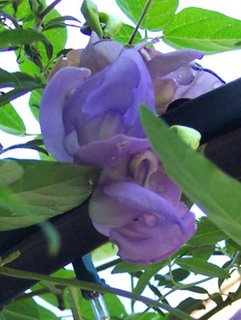
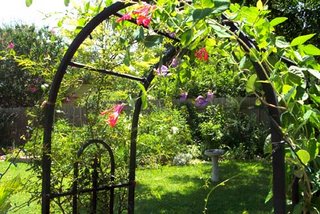
This floral combination on the metal arch is really pleasing me right now, although it sure is not what I’d planned. Earlier in spring, the Lady Banks yellow rose threw her yellow-blooming canes onto the arch from the left side. Now the native coral honeysuckle and what’s probably a Snail vine are growing up from the right side. In March, I was delighted to find the vine, supposed to be annual here, as inexpensive little plants from the Travis County Master Gardeners’ booth at Zilkerfest/Florarama, labeled as Vigna caracalla.
Before the fest, I’d been mining garden sites for information on Corkscrew and/or Snail vine, and found many heated and conflicting opinions. Some insist that Phaseolous caracalla refers only to Snail Vine, a related but separate genus, producing lavender, scentless blooms. They say that Vigna caracalla is the scented plant that is seen at Monticello. Other online experts were just as positive that Phaseolous was an outdated name, that the species was moved into Vigna, and that the scent and color were a result of selection, with both the fragrant and non-scented versions sharing the same name.
Naturally, I was hoping that mine would turn out to be the fragrant white one with blushes of yellow & purple, and thought it would look wonderful with the honeysuckle.
Just as naturally, both of mine turned out to be the lavender one with no fragrance. And the ants adore it. Although this snail vine may not have the scent and color of the corkscrew vine, growing it on the arch lets me see its intricate shape at eyelevel.

 About half way to the destination, the little “V” between the sharp peak and the rounded one, it had warmed up considerably. The drop in elevation helped but so did the sun reflecting off the walls of the surrounding mountain sides.
 The Window is the exit point for all rain water from the Basin to the desert. As you get closer to the Window, about the last half-mile or so, the trail becomes solid stone that has been eroded by the force of the water flowing over it. There were several areas with pools of standing water.
 The end of the trail. When it rains the water flows off the edge 200 feet to the desert floor below. I imagine it is quite an impressive waterfall when there is a lot of rain. On certain days of the year the sun can be seen setting between the opening of the “v” between the two rocks in the center.
 I couldn't get a picture of the full height of the rock on either side, but the view was impressive.
 And the obligatory self-portrait at the end of the trail. Perhaps it was because of the other hikes I had taken but this was by far the easiest trail I had been on. Except for a few spots, notably at the beginning, the trail descends gradually so it is a much easier trek back than the other trails.
 For the first time since I've been staying in Vienna, there was a bicycle all my own waiting for me when I arrived. Here is Jacqueline again, courtesy of my friend Wolfgang - famous here not only for his fantastic vintage collection, but also for his bicycle touring and bicycle moving endeavors.
 Since our last time together, Jacqueline has been given a leather saddle and is now more beautiful and comfortable than ever. The saddle is a sprung
  Still trying to adjust to the transition from Bostonian to Viennese cycling, I nearly missed this girl in front of me with a spectacular crocheted dressguard on her bike.
 Here is the best close-up I could get. I love these vintage crocheted dressguards, and in Vienna you can actually see them occasionally "in the wild".
 Wolfgang also has some nice ones on one of his collector bikes, but that bicycle is too old and valuable to cycle round the city. Crocheted dressguards are a passion that I try to suppress due to how difficult to find they are, but I am always looking. The only place I know of where you can get new ones nowadays is Simeli in the Netherlands, and I hope to review one of those soon. A couple of people have also emailed me about some handmade projects, but I have not had any follow-ups (let me know if you've seen or heard anything on that front).
 Another gumby happy with his Ergos ;)
 Photo courtesy of Jon Griffith @ Alpine ExposuresUeli Steck and his Ergoson Super Coulior Direct

